
Why Better Product Information Builds Buying Confidence

Martin Lotz III
Better product information builds buying confidence by answering the question every shopper brings to a product page: is this the right thing for me. The question is not whether the product is exciting or urgent. Every piece of missing information is a reason to hesitate, open a new tab, and check somewhere else. Every piece of clear, accurate information is a reason to stay and decide.
I think about buying confidence constantly because Lotz Outdoors sells gear people actually use outdoors. Fit, capacity, weather resistance, and compatibility are not abstract details for that kind of gear. If a customer buys a pack that is too small for a multi-day trip because the listing never mentioned volume, that is not a marketing failure. The undersized pack is a real problem for a real person, and it usually comes back to me as a return or a frustrated support email.
Is confidence the same as persuasion?
Confidence is not the same as persuasion. A lot of ecommerce advice treats every product page as a persuasion problem: how do we get this person to buy right now. The persuasion framing pushes toward urgency banners, countdown timers, and vague superlative claims. Persuasion tactics can work for a single-product launch with a short-term goal. Persuasion is a weaker foundation for a catalog business that depends on repeat customers and trust over years, not one impulse purchase.
Confidence works differently than persuasion. Building confidence is not about convincing someone despite their doubts. Confidence comes from removing the doubts that should not be there in the first place: not knowing the dimensions, what is included, or whether it fits what they already own. A page that answers those questions plainly lets a shopper say yes because they actually know what they are buying, not because they were pushed.
Where does uncertainty actually come from?
Uncertainty on a product page usually comes from a short list of gaps:
- Missing specifications. No dimensions, no weight, no materials, no compatibility information.
- Vague benefit language. Claims like premium quality or built to last that do not explain what makes that true.
- No sense of who the product is for. A listing that could describe ten different products in ten different categories tells the shopper nothing about whether it fits their specific situation.
- Inconsistent structure. If every page on your site is organized differently, shoppers cannot build a habit of where to look for the answer they need. So they give up and search elsewhere.
Fixing these gaps does not require hype. The fixes require information the merchant already has, presented clearly and consistently. Baymard Institute's usability testing on product descriptions found that when key compatibility information is missing or incomplete, users either research off-site or abandon the product altogether.
How does the five-part structure reduce uncertainty?
The five-part structure reduces uncertainty because each part closes a specific kind of doubt. The five-part product-content model is a high-impact opening, a short summary, a feature and benefit list, a detailed description, and technical specifications. The opening tells a shopper immediately whether they are in the right place. The specifications answer the exact factual question that would otherwise send them looking elsewhere. The feature-benefit list explains, rather than just asserts, why the product might work for them.
Complete information can reduce uncertainty and support conversion, but it is not a guarantee that every visitor becomes a buyer. Some shoppers will read a complete, honest listing and correctly decide the product is not right for them. A shopper who walks away informed is not a failure of the page. The page is doing its job: helping the customer make a genuine decision rather than manufacturing a sale that leads to a return two weeks later.
What does a confidence-building claim look like?
A confidence-building claim is specific and checkable. Compare two versions of the same claim. Version one: this jacket keeps you warm in any condition. Version two: insulated with 650-fill down and a windproof shell, rated for temperatures down to 20 degrees Fahrenheit in calm conditions.
The second jacket claim is more specific, more checkable, and more useful to a shopper trying to decide if the jacket matches their actual trip. The specific version also happens to be more persuasive, because specificity reads as honesty. Vague superlatives read as marketing, and most shoppers have learned to discount marketing on sight. Nielsen Norman Group's research on how users read on the web found that promotional "marketese" imposed a cognitive burden on users and was disliked.
Why does this matter more for a catalog business?
Accurate information matters more for a catalog business because trust compounds across many purchases. A one-product store selling a single item can sometimes get away with hype, because it only has to close one type of sale. A catalog business selling hundreds or thousands of different products cannot rely on hype. The same shopper will not come back if the last purchase disappointed them because the page oversold what the product actually did. A shopper who buys once, gets exactly what the page described, and has a good experience is far more likely to come back for the next purchase. A shopper who felt persuaded into something that did not match expectations is not.
How this shows up in the Enrichio workflow
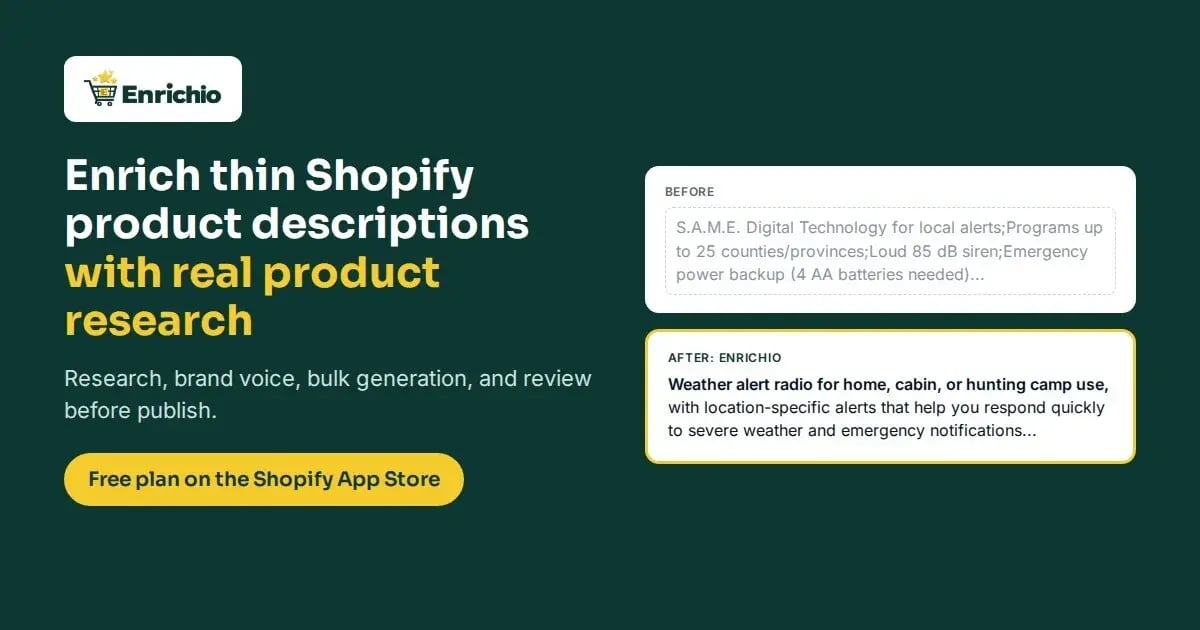
Enrichio is built around research and structure rather than exaggeration, partly for these reasons. When you build a template, you are deciding how your store will consistently answer a shopper's real questions: what is this, who is it for, what does it do, and what are the facts. Generation fills that structure in with researched information specific to the product, not embellished claims designed to create urgency. Review, the final step before publishing, is your chance to check every claim on the page. Every claim should be something you would be comfortable standing behind if a customer asked about it directly.
A quick confidence check for any listing
Before publishing a description, ask:
- Could a shopper tell within a few seconds whether this product is meant for them?
- Are the specifications specific enough to actually answer a comparison question?
- Is every benefit claim tied to a real, verifiable feature?
- Would I be comfortable if a customer asked me to justify every sentence on this page?
A yes to all four questions means the listing is doing its job: giving the customer enough information to decide, honestly, whether this product belongs in their cart.
What this looks like across a whole catalog
One well-written listing is a nice example. A whole catalog that behaves this way is a business advantage. When every product page in your store follows the same structure and answers the same categories of question, shoppers stop treating each new product as a fresh research project. Shoppers learn, without being told, that your specifications section always has the numbers they need. Shoppers also learn that your feature list always explains the point of each feature. Familiarity is part of what makes a large catalog feel trustworthy rather than random.
Consistency and confidence overlap at the catalog level. A single great product page can build confidence in that one purchase. A catalog of consistently complete pages builds confidence in the store itself, which is a much larger and more durable asset. Getting there by hand across a large catalog is slow. Getting there through a repeatable, template-based workflow is the whole reason a system like Enrichio exists. Build the structure once, apply it consistently, and let review catch anything that needs a second look before it reaches a customer.
Written by Martin Lotz III, founder of Enrichio, Inc. and owner of Lotz Outdoors, a Shopify store with roughly 60,000 products. Read why Martin built Enrichio, or send a question to Enrichio Support.