Why Manufacturer Product Descriptions Are Costing You Sales

Martin Lotz III
Manufacturer descriptions cost you sales because a hundred stores publish the same supplier copy for the same product. A shopper who lands on any one of those pages has no reason to buy from that store rather than any of the others, so price becomes the only tool left. The supplier copy also skips many of the questions your own shoppers ask.
Most Shopify stores begin with the same supplier copy. The supplier copy arrives in a feed, in a spreadsheet, in a distributor's product sheet, or embedded in an EDI file. Supplier copy is fast to add, and it feels safe: the manufacturer wrote it, so it must be right. Once the copy is on the product page, no one thinks about it again.
The comfort of supplier copy is expensive. A store running on identical text has effectively opted into a commodity fight. I have watched this play out inside my own catalog. I have also watched it reverse when we replaced manufacturer copy with descriptions that actually reflected who was selling the product and why.
What do identical descriptions actually cost you?
Identical descriptions rarely cost you anything visible on a single page. The cost shows up in patterns:
- You compete on price by default. When the words on the page are identical to a competitor's page, price becomes the only remaining variable. Every shopper is a tab away from the same product at a store next door.
- You leave customer questions unanswered. Manufacturer copy is written for the manufacturer's needs, not the customer's. Supplier copy emphasizes features and marketing language. It often skips the questions your specific shoppers ask: does this fit, how heavy is it, what is in the box, is it compatible with what I already own. Nielsen Norman Group's product page research found that insufficient product information leaves shoppers without enough to make a purchase decision.
- You look interchangeable to search and AI systems. A page that offers no unique information gives search engines and AI systems no reason to treat it as authoritative. Google says duplicate content is not a violation of its spam policies, so identical copy will not automatically penalize your rankings. Identical copy will not help you stand out either, and it simply blends in. Unique, useful content can help search systems understand the page, and Google's helpful content guidance asks whether a page provides original information and substantial value compared with other pages.
- Your brand voice never lands. If every product page reads like it came from a different supplier, the catalog feels like a warehouse rather than a store. The inconsistency undermines the trust you are trying to build across the rest of the site.
- You cannot answer service questions with your own words. When a customer emails support and you check your own product page, you are quoting the supplier back at them. The moment is small, but it accumulates.
The costs of supplier copy do not show up in a single sale you obviously lost. They show up as the sales you never quite made and the shoppers who bounced to a competitor. They also show up as returns from customers who could not tell whether the product was right for them.
Why does supplier copy feel safe when it is not?
Supplier copy feels safe because it has three qualities that make it look like the responsible choice:
- Supplier copy is available.
- Supplier copy is written by the people who made the product.
- Supplier copy saves the merchant time.
All three qualities are true. None of them survive contact with a large, competitive catalog.
Availability is not an advantage when every competitor has the same access. The manufacturer wrote the copy for their own marketing objectives, which are not the same as yours.
The time saved on the day the product was listed is repaid many times over. The repayment comes as lower conversion, higher support load and thinner differentiation. The savings evaporate as soon as anyone tries to grow the store.
What does a better product description look like?
A better product description gives the customer more useful information than the manufacturer sheet does, in a structure that reflects your store. Differentiation is not about being clever. A complete product listing has five parts worth writing yourself, or generating with a workflow you control:
- A high-impact opening that answers who the product is for and the single reason it exists.
- A short summary that gives a scanning shopper the core value in a few sentences.
- A feature and benefit list that pairs each verified feature with a plain-English reason it matters to the customer.
- A detailed description that covers use, materials, design, brand context, and how it compares to the alternatives you also sell.
- A technical specifications block that presents the product's facts in a consistent, scannable format across your catalog.
A listing does not need to be a thousand words. Every listing does need to answer the same set of questions in the same order, in your voice, using researched information rather than the supplier's boilerplate.
Why do merchants stop replacing supplier copy?
Merchants stop because doing the work by hand across thousands of products is unsustainable. Most merchants know the copy is a problem, and I stopped for the same reason for a long time. The manual loop looks like this:
- Export the catalog to CSV.
- Copy a product into a chat window.
- Retype the same instructions.
- Paste the result back into the spreadsheet.
- Re-import.
- Fix broken listings.
- Repeat for the next batch.
A merchant working this way gets through fifty products and realizes four thousand are left. By then, the supplier has already updated the feed on half of them.
The manual workflow is the actual reason supplier copy stays on the site. Merchants do not prefer generic descriptions. The cost of replacing them product by product is simply higher than the cost of leaving them alone.
How does Enrichio change that math?
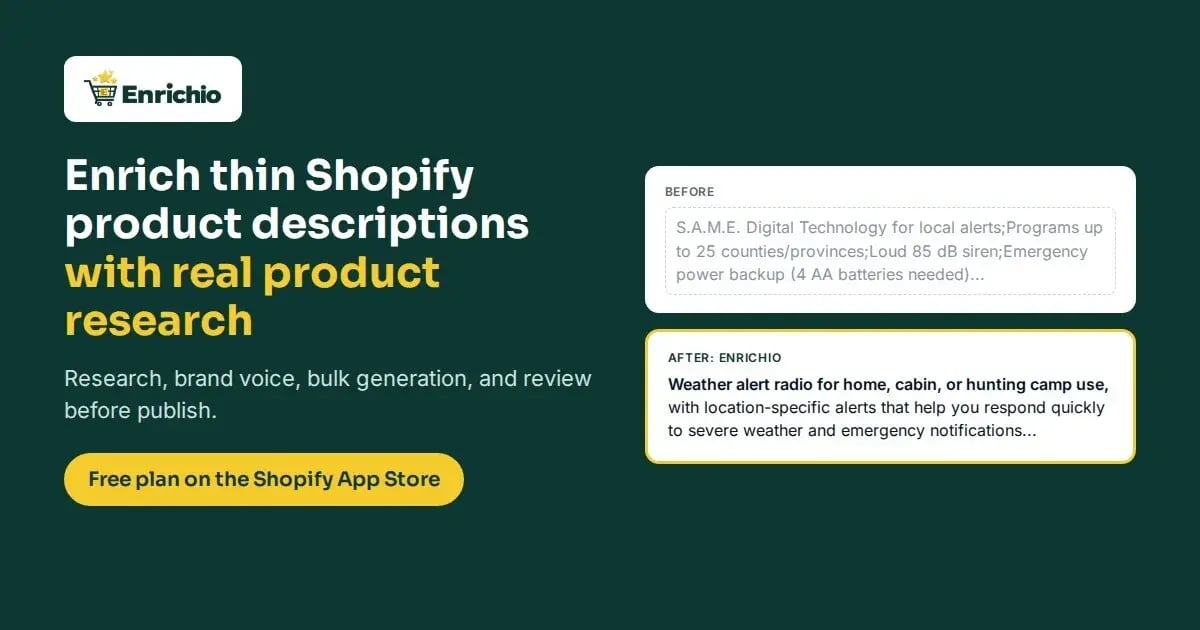
Enrichio compresses the manual workflow into something a small team can actually run. You build a reusable template once and load products directly from Shopify. Enrichio generates structured drafts using researched product information. You review and refine the drafts, then publish approved descriptions back to your store.
Each part of the Enrichio workflow does one job. The template makes the format consistent. The research makes the content specific to the product rather than a rearrangement of the words already on the page. The review step means you never publish something you have not seen.
Enrichio does not promise higher rankings or a specific conversion lift. Enrichio does give you a fast, controlled way to replace supplier copy with unique, complete listings. The speed matters at the scale where doing this by hand stops being possible. That scale is the point where differentiation becomes achievable rather than aspirational.
Where to start this week
A small, honest test is enough to see whether replacing supplier copy is worth doing. You do not need to rewrite the whole catalog:
- Pick ten to twenty products that are important to your store: high-traffic pages, high-margin items, or listings you already suspect are underperforming.
- Open each product page next to a competitor's page for the same product. Note where the descriptions are identical.
- List the customer questions your support team hears most about that category: care instructions, sizing, compatibility, what is in the box, warranty. Any question that is not answered on your page is a candidate for the rewrite.
- Draft new descriptions using the five-part structure above. Keep the manufacturer's factual specifications, and replace the marketing copy with your own explanation of use, benefit and context.
- Publish, wait four to six weeks, and compare product-page conversion, support ticket volume for those SKUs, and organic impressions in the Google Search Console Search performance report.
If the numbers move on twenty products, they will move on two thousand. At that point, a workflow like Enrichio stops being optional. Load a small group of products, identify the listings with the greatest opportunity, and see for yourself what unique product content changes.
Written by Martin Lotz III, founder of Enrichio, Inc. and owner of Lotz Outdoors, a Shopify store with roughly 60,000 products. Read why Martin built Enrichio, or send a question to Enrichio Support.