
How Enrichio Researches a Product Before It Writes

Martin Lotz III
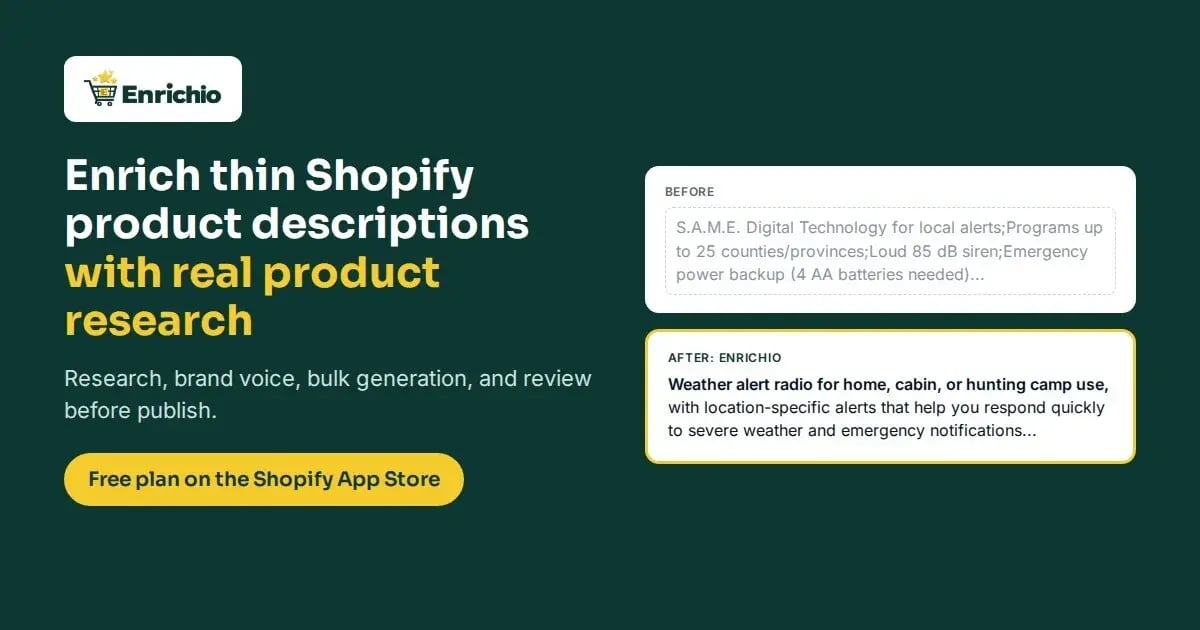
Enrichio researches a product before it writes anything. It gathers signals about the product, the brand, the specifications, the likely customer and your template instructions, then organizes what is actually knowable into a five-part description. A general AI chat tool does the opposite: it rephrases the thin supplier copy you paste in, so you get more words but rarely more information.
Enrichio is built around research first and writing second because of what I saw while fixing descriptions across the Lotz Outdoors catalog. The rephrased output looked longer and more polished. It often repeated the same idea in three different sentences. A customer reading it still could not answer the questions that mattered: what is this made of, who is it for, will it fit what I already own. Nielsen Norman Group's product page research describes the same failure: insufficient product information leaves shoppers with unanswered questions and not enough to make a purchase decision.
The input sets a ceiling on the output. If the supplier description is the only source of truth, the new description can never be more complete than that supplier description. Something has to add the missing information, and that something has to be research, not rephrasing.
What does Enrichio look at when it researches a product?
Enrichio looks at a broader set of signals than the existing product title and the supplier's blurb. Those signals come from the product, the brand and the store, including:
- The product itself. Existing title, description, images and any structured data already present in the Shopify product record, such as variants, tags or product type.
- The brand. Known brand context that helps explain design choices, materials or positioning, without inventing brand history that cannot be supported.
- Specifications. Dimensions, materials, capacity, compatibility and other structured facts a buyer would need to compare this product to alternatives.
- The intended customer and use case. Who is likely to buy this kind of product and in what situation, so the opening and benefits can speak to a real use rather than a generic audience.
- The merchant's own instructions. Global and section-level instructions set in your template, which shape tone, structure and any claims to avoid.
The goal of the research step is not to guess or invent facts that cannot be supported. Enrichio gathers what is actually knowable about the product and organizes it into the five-part structure: opening, summary, features and benefits, detailed description, and specifications. Research fills in real information. Research does not fabricate it.
How is research different from rephrasing?
Research adds facts the existing text does not contain, while rephrasing only rearranges the facts already there. A general-purpose AI tool has no persistent understanding of your catalog, your brand voice or your template. Every time you paste a description in, you start from zero and repeat the same instructions you used last time. The tool will happily generate longer text. It has no built-in mechanism for finding the product's actual dimensions or verifying what materials it uses.
Enrichio closes that gap by treating research as a distinct step before generation happens. Enrichio does not assume the existing text already contains everything worth saying. Google's guidance on helpful, people-first content asks whether content that draws on other sources avoids simply copying or rewriting them and adds substantial value. The same test separates a description that sounds better from a description that tells the customer something new and true.
An example: from a thin listing to a researched one
A typical inherited listing has a product title, a SKU and one sentence of supplier marketing copy: "Durable and lightweight, great for everyday use." The supplier sentence is not false, but it is not useful either. The same words could describe thousands of unrelated products.
A rephrasing tool turns that supplier sentence into three sentences that all say some version of "durable and lightweight." A research-driven pass asks different questions instead:
- What is this product actually made of?
- What does "everyday use" mean for this specific product category?
- What dimensions or capacity would a buyer need to know?
- Who is the realistic customer for this item?
The resulting listing might state the actual material and construction. The researched listing might name a plausible use case supported by the product type. The researched listing would list real specifications instead of repeating the adjective "durable" in different words.
Where does research fit in the Enrichio workflow?
Research happens inside the generate step, so it is not a separate step you have to manage yourself. The Enrichio workflow has four steps: build a template, load products, generate, then review and publish. Once your template defines the structure you want and your products are loaded from Shopify, generation is where research and writing come together. The result is a draft that follows your five-part structure with the fullest information available for that product.
Does researched copy still need a human check?
Yes, researched copy still needs review before it goes live. Research-driven generation produces a stronger starting draft than simple rephrasing, but it does not remove the need for review. Specifications should be verified against the actual product, especially for anything safety-related, regulated or highly technical. Enrichio supports research and generation, but merchants should always confirm facts before publishing. Treat the draft the way you would treat a description written by a new employee before it goes live.
A short checklist before you generate
The research step works best when you give the workflow good material to work with:
- Make sure the product's title, type and any existing specifications are accurate in Shopify before loading it.
- Add any brand or use-case context you know to your template's global instructions, rather than assuming it will be inferred.
- Flag any claims you never want made, such as unverified health or performance claims, in your section-level instructions.
- After generation, check the draft against the actual product page, packaging or manufacturer spec sheet before publishing.
Better research produces a better draft, but the merchant is still the last line of defense for accuracy. Research plus review is the combination that turns a thin listing into one a customer can actually trust.
Why does research quality depend on the product record?
Research quality depends on the product record because research-driven generation is not magic. The workflow works better when the starting record is not completely empty. A product with a clear title, an accurate product type and at least a few real attributes gives the workflow something solid to build on. A product with a placeholder title, no category and almost nothing filled in gives it much less. The resulting draft will reflect that gap.
I recommend cleaning up the most basic Shopify fields before loading a batch of products for enrichment: title, product type and any obvious variant data. The cleanup takes a few minutes per product and meaningfully improves what research can find and use. Garbage in, garbage out is not a new idea. The rule applies just as much to a research-driven workflow as it did to my old spreadsheet-and-prompt process.
Why research matters more as your catalog grows
A merchant with a handful of products can personally research each one. The merchant can read the manufacturer spec sheet, check a competitor's page and ask the brand directly. Personal research does not scale to a catalog of a few thousand products, let alone the roughly 60,000 that Lotz Outdoors carries. At that size, the only realistic path to complete listings is a workflow that treats research as a repeatable step. A one-off task performed by a single overworked person will not keep up.
The practical argument for research-driven generation over manual rephrasing is about scale. A human researcher would not do a worse job on any single product. No team of a realistic size can do that job by hand across an entire catalog and keep it current as products change.
Written by Martin Lotz III, founder of Enrichio, Inc. and owner of Lotz Outdoors, a Shopify store with roughly 60,000 products. Read why Martin built Enrichio, or send a question to Enrichio Support.