Welcome to Enrichio: A Better Way to Build Shopify Product Content

Martin Lotz III
Enrichio is a Shopify product-enrichment platform. It turns basic, incomplete or inconsistent supplier copy into structured, detailed, brand-aligned product listings. It does that with a reusable template, AI-assisted research and generation, and a review-and-publish workflow inside Shopify. I built Enrichio because I could not keep up with my own store.
Lotz Outdoors grew into a Shopify catalog of roughly 60,000 products. Most of them were inherited from suppliers with wildly different ideas of what a product description should look like. Some listings were usable. Many were thin summaries, missing specifications, poorly punctuated, or clearly copied from a manufacturer sheet dozens of other stores were also using. I wanted every product page to help a customer make a real buying decision. I did not have a team of writers to make that happen.
The sections below cover how Enrichio grew out of that problem, what it does today, and why it is built the way it is. If product content has become a bottleneck in your Shopify store, you should recognize your own situation.
What workflow was I trying to escape?
I was trying to escape a manual process built on CSV exports, a general AI tool and risky re-imports. For a while, I ran product enrichment by hand. The process looked like this:
- Export product data from Shopify into a very large CSV.
- Open the CSV in a spreadsheet and pick a batch of products to work on.
- Copy a product description and any supporting data into a general AI tool.
- Type the same instructions I had typed the last thousand times.
- Research the brand, the product, the specifications, and the intended use case in separate browser tabs.
- Copy the generated content back into the spreadsheet.
- Prepare the file and re-import it into Shopify.
- Check later to see whether the import worked.
- Repair failed imports, overwritten fields, formatting problems, or listings that had been mismatched to the wrong product.
- Start again for the next batch.
The re-import step carried the most risk. Shopify's guide to importing products with a CSV file explains that when you overwrite products with matching handles, CSV values replace existing values, and blank columns can wipe them.
I eventually wrote a custom tool that could manage most of this from a large CSV file. The tool ran for much of a day. It was useful, but it was not dependable enough to scale. Runs errored, fields overwrote each other, and descriptions ended up on the wrong products. I could troubleshoot the failures because I understood every step in the pipeline, but I could not hand that work to anyone else. The process was a house of cards that required me personally to hold it up.
The custom tool clarified what the real product needed to solve. The biggest missing pieces were speed and user-friendliness, followed by direct Shopify integration and safety. The desired experience was not another external AI tool. The goal was a workflow that lived inside Shopify and ran in bulk with a few clicks. The workflow had to produce consistent output from a reusable template. The merchant also needed to review, approve, publish, and roll back without juggling files or leaving the platform.
What is Enrichio?
Enrichio is a Shopify product-enrichment platform that turns basic, incomplete, or inconsistent product data into structured, detailed, brand-aligned product listings. It uses a reusable template, AI-assisted research and generation, and a controlled review-and-publish workflow. The finished copy goes into the product description, which Shopify stores as HTML in the descriptionHtml field of the Product object.
A few things Enrichio deliberately is:
- A product-enrichment workflow, not a prompt box that stretches existing text into a longer version of the same thing.
- A Shopify-embedded process designed to remove the exports, giant spreadsheets, repeated prompting, and risky re-imports.
- A reusable template system, so the format of a listing is decided once and applied consistently across products and brands.
- A research-driven content system that looks for the product, brand, specification, and use-case information a shopper actually needs, rather than expanding the words already on the page.
- A merchant-controlled publishing system with preview, review, edit, approval, and recovery.
A few things Enrichio is not:
- Not a hype generator. Enrichio is not designed to manufacture urgency or exaggerate what a product can do.
- Not a promise of automatic rankings, a specific conversion lift, or hands-off publishing without merchant oversight.
- Not a one-time copywriting service. The value of Enrichio is the repeatable workflow, the consistency, the safety, and the ability to scale that work across a catalog.
How does the four-step Enrichio workflow work?
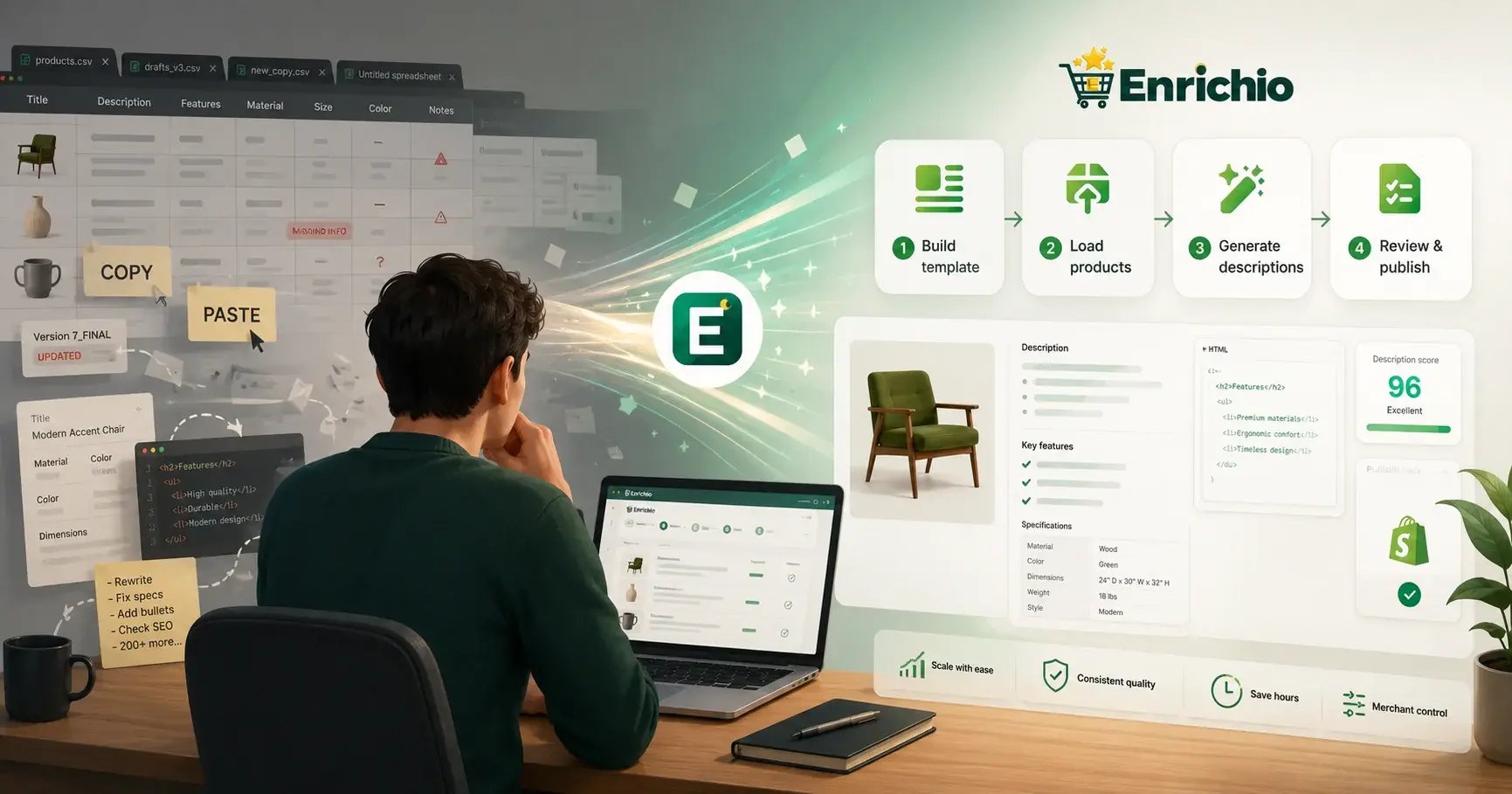
Enrichio works in four steps: build a template, load products from Shopify, generate descriptions, then review and publish. Every part of the product is organized around those four steps:
- Build a template. You create the reusable description format that will be applied to your future enrichments. The template determines structure, ordering, and presentation. Global instructions control overall tone, brand voice, and rules. Section-level instructions can refine how an individual part of the listing is generated.
- Load products from Shopify. You pull products into Enrichio instead of exporting to a separate spreadsheet. You can browse the catalog and see which listings look thin or incomplete. Then you choose which products to improve before you spend time or credits generating anything.
- Generate descriptions. You select products, apply your template, and let Enrichio draft structured HTML descriptions. Each draft uses your instructions, your brand voice, and researched information about the product. What comes back is a draft, not a finished truth.
- Review and publish. You preview drafts, refine the output, approve the content, and import the finished descriptions back to the correct Shopify products. Review is the safety layer, not an afterthought. Review is a direct response to every failed import, accidental overwrite, and mismatched listing I have lived through.
Why product enrichment, and not just AI descriptions?
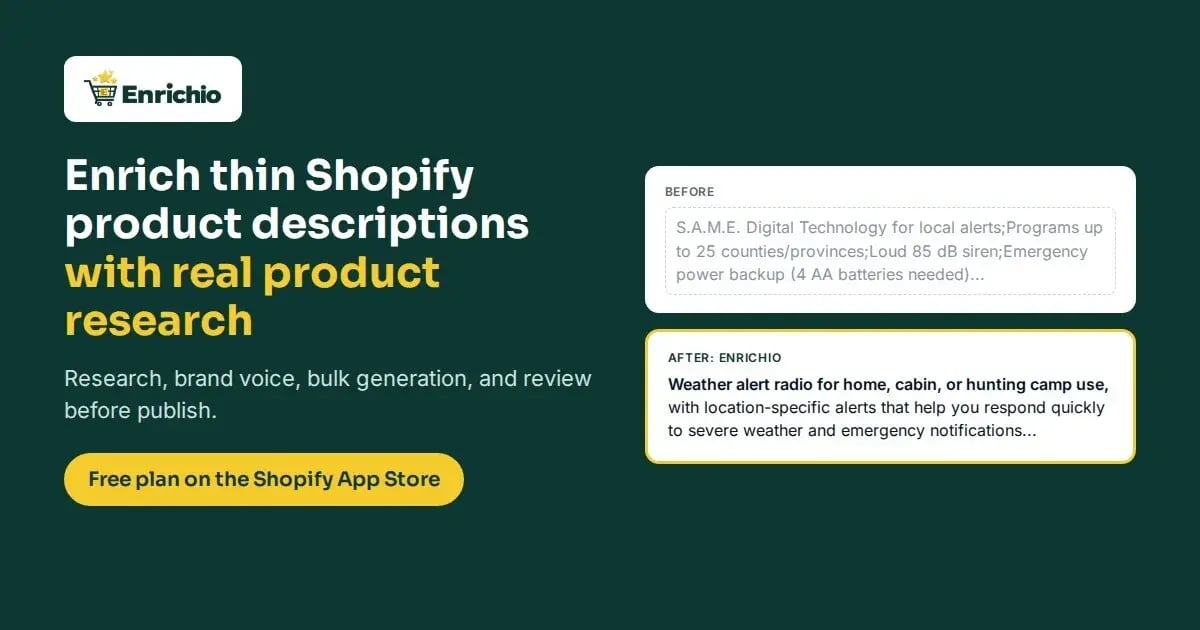
Product enrichment adds the information a shopper needs, while general AI descriptions mostly add words. General-purpose AI tools have a real weakness for ecommerce. Ask them to help with a product listing and they usually take the small amount of information on the page and add more words to it. The result is longer copy that says the same thing. The copy reads well, but it does not actually help a shopper decide whether the product is right for them.
Product enrichment is different. Enrichment means turning basic or generic product data into a complete product listing. A complete listing introduces the product clearly, connects features to customer outcomes, and provides trustworthy detail. A complete listing also reflects the store and brand, and includes the specifications a buyer needs to evaluate the product. Baymard Institute's usability testing on product descriptions found that when a description fails to meet users' expectations, many simply abandon the product. Enrichio treats a listing as five parts:
- A high-impact opening that says what the product is, who it is for, and the primary benefit.
- A short summary description that gives a scanning shopper the core value in a few sentences.
- A feature and benefit list that pairs each verified feature with a reason it matters.
- A detailed description that covers use, materials, design, and differentiators.
- Technical specifications like brand, SKU, dimensions, weight, materials, and compatibility.
Enrichio is built to fill those five parts consistently, from your template, using researched product information, in your brand voice. Filling five defined parts is a different job than writing a longer paragraph.
Who is Enrichio for?
Enrichio is built for Shopify merchants, ecommerce managers, catalog managers, product-content specialists, founders, and agencies who are responsible for product pages. Enrichio is most useful when you have more products than you can reasonably research, rewrite, format, and maintain by hand. That includes multi-brand retailers with inconsistent supplier feeds, stores with hundreds or thousands of listings, and lean teams that cannot hire a large content department.
Smaller catalogs can still benefit. If you want a consistent brand voice across your listings, or a small number of important products need serious improvement, the same workflow applies. Enrichio is not only for massive stores. The time-saving and consistency advantages simply become more obvious as the catalog grows.
What I want you to take away
Product enrichment is not a shortcut around writing. Product enrichment is a way to give the customer the information they need to make a buying decision. Enrichment does that consistently, across a catalog too large for one person to touch every listing by hand. Enrichio exists to make that possible without turning you into a prompt engineer or forcing you to babysit a spreadsheet.
The best way to see what enrichment means in practice is to build your first template, load a small group of products, and generate one enrichment. Compare the result against the original supplier description. That comparison, on your own catalog, is what convinced me the workflow was worth building in the first place.
See how Enrichio can turn basic product data into a complete, consistent product listing. Verify current trial and install terms before you start, and expect to review the first drafts closely. Close review is not a limitation. Close review is how a merchant-controlled AI workflow is supposed to work.
Written by Martin Lotz III, founder of Enrichio, Inc. and owner of Lotz Outdoors, a Shopify store with roughly 60,000 products. Read why Martin built Enrichio, or send a question to Enrichio Support.